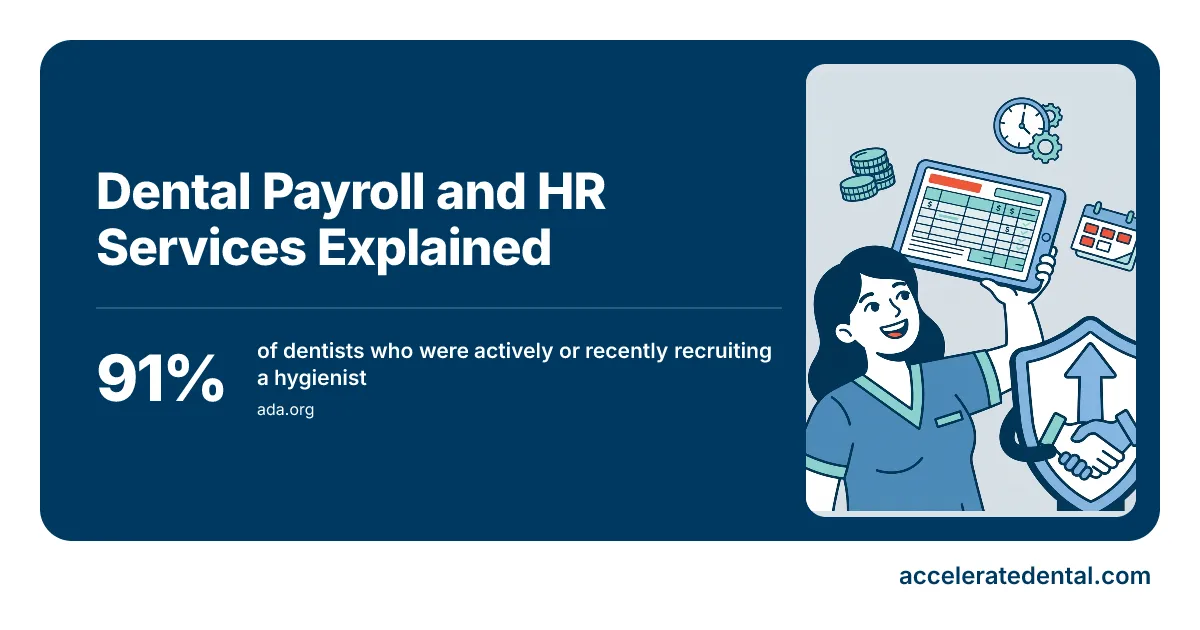

Summary: Payroll services for dentists should do more than issue checks: they connect wages, tax withholding, benefits deductions, timekeeping and employee records with HR processes from hiring through separation. Support can include onboarding, wage setup, paid-time-off rules, payroll approvals, handbook and recordkeeping support, and final-pay steps, while the doctor-owner retains decisions about compensation, staffing and workplace culture.
A hygienist asks why her retirement deduction changed, the office manager is covering phones, and payroll has to close before the next deposit file goes out. That is not just a question about whether the paycheck is right. It is a question about who owns the employment decision behind the paycheck when benefits, classification, overtime, and onboarding all touch the same record.
A dental practice can buy payroll processing almost anywhere, but dental payroll and HR services explained plainly means one thing: wages, benefits, compliance steps, and employee records have to work together, not sit in scattered admin tasks. Our view is direct. A practice owner should not become the backup HR department just because the office wants to stay independent.
For dentists, the choice is not between doing everything yourself and handing control to private equity. The better choice is deciding which employment administration belongs outside the operatory, which decisions stay with the doctor-owner, and what level of support fits the risk.
What should dentists payroll services include beyond checks?
Beyond issuing checks, dental payroll and HR support should connect tax withholding, benefits deductions, timekeeping, onboarding and employee records. Payroll processing produces the pay-date output; HR administration maintains the employment information behind it.
A dental practice needs both because a hygienist's wages, a dental assistant's overtime status, a front desk coordinator's benefits enrollment, and an office manager's personnel file stop being separate problems once payroll runs. Dental payroll and HR services explained in practice means the provider or support team handles the employment record from hiring through separation. The work usually includes onboarding documents, wage setup, tax withholding, benefit deductions, paid time off rules, payroll approvals, employment posters, handbook support, recordkeeping, and final-pay steps when someone leaves.
Dental office admin breaks down when payroll is treated as a clerical task after the schedule is full. A front desk coordinator who is also confirming patients, checking claims, and calming a staffing gap should not be the last line of defense for whether a new hire completed tax forms or whether a deduction limit was updated before payroll cutoff.
Dental practice administration also needs a clean approval path. The doctor-owner should decide compensation philosophy, staffing structure, and culture standards. The support team keeps the process documented and repeatable, so the same rule applies when the office is busy, short-staffed, or preparing for a transition.
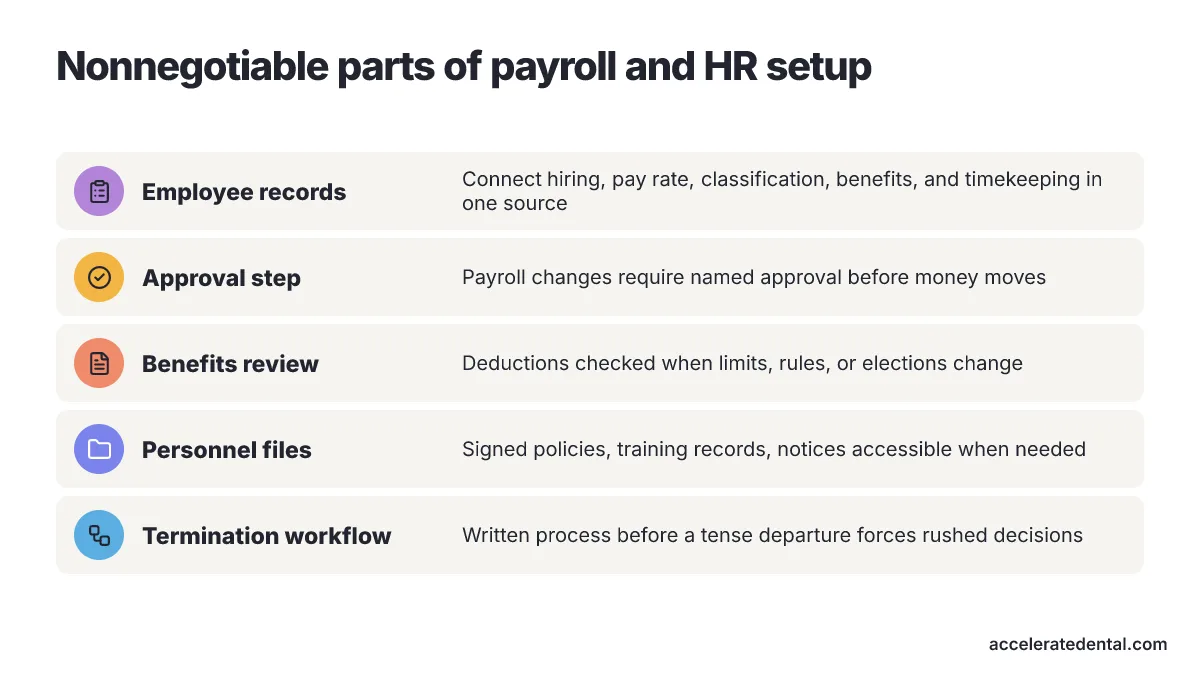
For a workable payroll and HR setup, use the following operating checklist. These are responsibility-map recommendations, not a complete statement of employment-law requirements:
- Employee records must connect hiring, pay rate, classification, benefits, and timekeeping in one source of truth.
- Payroll changes must require a named approval step before money moves.
- Benefits deductions must be reviewed when contribution limits, plan rules, or employee elections change.
- Personnel files must hold signed policies, training records, and notices in a place the practice can access when needed.
- Termination and final-pay workflows must be written before a tense departure forces rushed decisions.
A dentist who wants back-office support for HR and legal issues is really asking for relief from the employment system, not just a cheaper payroll run. The next decision is whether the practice needs a payroll vendor, an HR platform, or a broader operating partner.
Why dental payroll is different from generic small-business payroll
Dental payroll needs to reflect clinical schedules, role-specific pay arrangements, benefits and assistant coverage, rather than only calculating take-home pay. Payroll mistakes can strain employee trust, but the staffing evidence should not be read as proof that a particular payroll service improves retention.
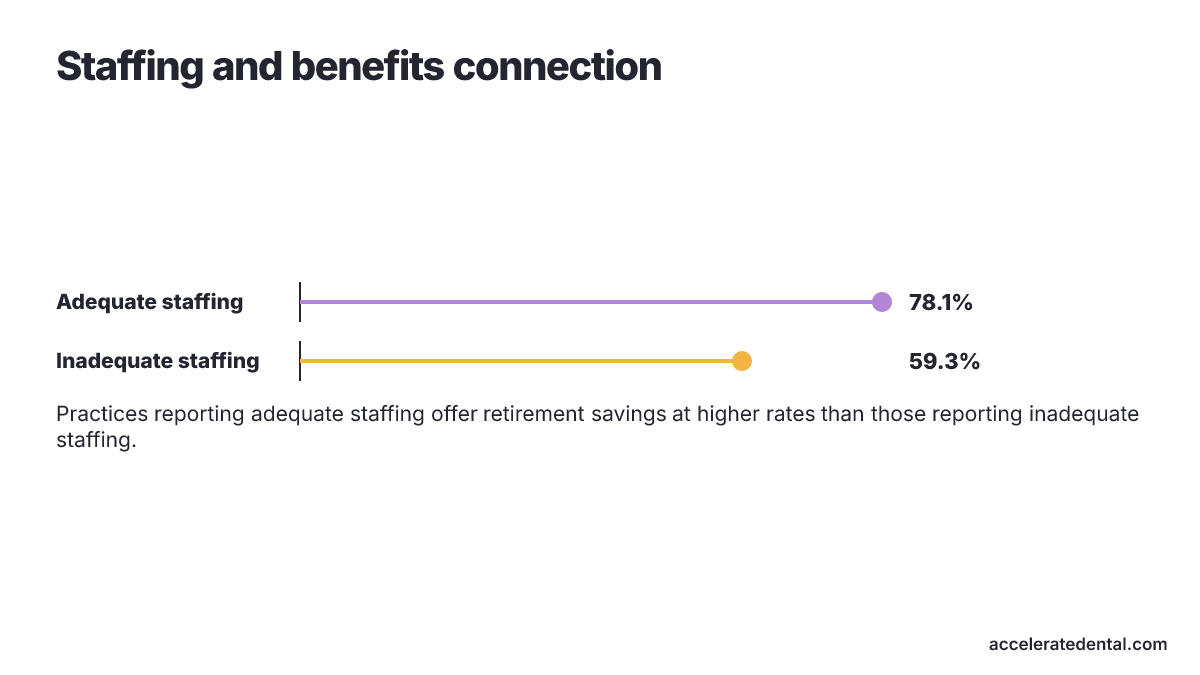
The accompanying illustration presents a staffing-and-retirement-benefits comparison. The linked ADA report about practices reporting adequate staffing was reachable, but its figures could not be independently text-verified in this review. Treat the illustration as an unverified comparison, not a benefits benchmark or evidence that retirement benefits cause adequate staffing.
Dental employers compete for jobs that are hard to fill. For May 2025, the U.S. Bureau of Labor Statistics reports that dental hygienist wage data put the median annual wage at $98,100, while May 2025 dental assistant wage data put the median annual wage for assistants in dentists' offices at $48,000.
Payroll accuracy matters because the labor market gives good employees choices. The American Dental Association reported in April 2026 that hygienist recruiting difficulty was very or extremely challenging for 91% of dentists who were actively or recently recruiting a hygienist. Compensation is not the only reason dental team members leave, but payroll and HR are where pay, benefits, and workplace consistency show up in plain view.
When reviewing support, consider how the practice handles concerns about pay, benefits and workplace culture. The ADA report on dental staff attrition factors is retained as background reading, but its detailed findings could not be independently text-verified in this review. It should not be treated here as evidence that a payroll service reduces turnover.
Generic small-business payroll will usually calculate gross-to-net pay, file payroll taxes, and produce direct deposits. Dental-specific administration has to account for clinical schedules, hygiene production pressure, recall gaps, bonus structures, continuing education time, sterilization and assistant coverage, and the reality that one missed hire can change the day's production plan.
A practice owner should be skeptical of any service that treats HR as a policy library with no operating rhythm. The useful support is not a binder of rules, but a cadence: payroll review before submission, documented onboarding before the start date, classification review before role changes, and benefits reconciliation before deductions become a complaint.
The staffing evidence points to a practical standard for dental owners. Payroll and HR should protect trust with the team first, because a practice cannot recruit its way out of sloppy employment administration.
How should a dental practice manage payroll and HR rule changes?
A dental practice should assign responsibility for payroll and HR rule changes, document the required action, test affected settings and communicate changes in writing. Federal updates matter when they alter deductions, retirement-plan setup or employee classification. The practice owner does not need to become a benefits lawyer, but the practice does need someone responsible for translating rule changes into payroll settings and employee communication.
In November 2026, the IRS issued final automatic-enrollment rules for certain retirement plans, giving affected employers time to prepare payroll processes before the rules generally apply to plan years beginning after 2027. Dental practices with retirement plans should confirm whether the plan design triggers automatic enrollment steps and who updates payroll deductions when eligibility begins.
In November 2026, the IRS announced 2027 contribution limit increases, raising the employee 401(k) contribution limit to $25,500 from $24,500. Practices offering retirement benefits should update payroll deduction limits before the first payroll affected by the new limit, not after an employee notices a stopped or excess deduction.
In May 2026, the U.S. Department of Labor revised overtime regulations after judgments to reflect court decisions vacating the 2024 overtime rule. Dental practices should review employee classifications against applicable federal and state requirements rather than assuming an old salary setup still fits every office role.
The linked HR for Health and Kwikly hiring and compliance resources announcement was inaccessible during verification. Do not rely on that link to establish a launch date, service scope or live platform integration. Confirm current capabilities in the vendor's service documentation and agreement before planning an onboarding workflow around them.
A vendor connection does not replace the owner's need to choose who is accountable inside the practice. An announcement is not a substitute for a documented division of work between the staffing provider, HR support and payroll processor.
Regulatory updates can be harder to manage when responsibility is split. A certified public accountant (CPA) may know tax filing, a payroll processor may know deduction fields, an HR vendor may know templates, and the doctor-owner may still be the person blamed when the team receives unclear answers.
A good rule-change process is simple enough to repeat:
- Assign one owner for each employment category: payroll tax, benefits, classification, onboarding and personnel files.
- Put every rule change into a short operational note that says what changes, who is affected and when payroll must be updated.
- Test deduction and classification changes before the first affected payroll closes.
- Keep employee communication in writing so the office manager is not translating plan rules chairside.
Compliance support has value only when it changes what happens before payroll runs. The next choice is the type of support model that gives a dental practice enough accountability without handing away the practice itself.
How should a dental practice choose between payroll software, HR vendors and a partnership group?
Choose payroll software for processing needs, an HR vendor for employment-process support, or a broader partner when the back-office workload extends across functions. Match the scope to the practice's actual gaps and confirm responsibilities in the agreement.
A basic payroll processor can fit an office with steady roles, a simple benefits setup, and an internal manager already handling HR paperwork. Unless the agreement includes more, the practice still needs responsibility assigned for classification calls, handbook changes, hiring steps, and employee problems.
A dental HR platform suits a practice that wants better templates, onboarding help, and compliance reminders, while keeping most administration in the office. Someone inside the practice still has to keep records current, act on alerts, and tie HR policy to the actual schedule.
A broader back-office partner makes sense when the owner wants payroll and HR grouped with finance, legal and compliance, marketing, operations, and analytics instead of another vendor login. That model asks for more operational sharing than a software subscription. The owner has to review reports, accept process discipline, and define which decisions stay clinical and local.
A small single-location practice with a stable team, hourly payroll, no retirement plan, and a capable bookkeeper can reasonably stay with a basic payroll service and keep HR documents current through a separate adviser. Paying for a larger structure before the practice has enough complexity can turn support into overhead instead of relief.
At Accelerate Dental, we describe our model as a doctor-owned dental partnership built around continued doctor ownership, practice leadership and clinical control. The governing agreements should spell out the ownership interest, management authority and clinical decision rights that apply to a particular practice. Our back-office support covers finance, HR, legal and compliance, marketing, operations, insurance, fee optimization, and billing support inside a dental partnership group owned by dentists, not private equity.
Dentists comparing support models should separate the administrative-work question from the control question, whether a potential partner is backed by dentists or private equity. Who does the administrative work, and who controls the practice? Our article on majority ownership and autonomy goes deeper on why back-office power should not require surrendering the doctor's role as decision-maker.
Practice owners who feel buried by HR and legal administration should ask each potential support option a concrete set of questions:
- Who changes payroll settings when retirement, overtime, or benefit rules change?
- Who checks employee classification before a role or pay structure changes?
- Who owns onboarding documents before a new hire's first patient-facing day?
- Who keeps personnel files easy to reach when a manager leaves?
- Who gives the doctor-owner a weekly or monthly view of labor, collections, and administrative risk?
- Who helps the owner plan succession without turning the practice into a flip-and-sell asset?
A standalone vendor is not wrong when the problem is narrow. A dental partnership group may be worth evaluating when payroll and HR are signs of a wider back-office load that pulls the dentist away from ownership, leadership, and patient care. Whether that model is preferable depends on the scope, cost and governance terms, not the partnership label alone.
Compare the scope of payroll and HR support
Compare support models by the work included and the responsibility left inside the practice, rather than assuming that a broader label guarantees broader service.
| Support model | Scope to look for | Responsibility to confirm inside the practice |
|---|---|---|
| Payroll processor | Pay calculations, withholding, deductions, deposits and filing support specified in the agreement | Approving changes, supplying accurate records and arranging HR advice outside the processing scope |
| Dental HR vendor | Onboarding support, policy resources, employment records and compliance reminders specified in the agreement | Acting on alerts, keeping records current and connecting policies to daily operations |
| Broader back-office partner | Payroll and HR coordination alongside agreed finance, operations or other administrative functions | Reviewing reports, approving reserved decisions and checking ownership and governance terms |
What should be agreed before a payroll handover?
Before a payroll handover, document the records to transfer, the approvals required, the checks before submission and the person responsible for resolving errors.
- Scope and exclusions: Record which tasks the provider performs and which require a separate adviser or an internal owner.
- Record transfer: Reconcile employee details, pay arrangements, benefit elections, time records and leave balances against the practice's approved records.
- Approval and access: Identify who can enter a change, who approves it, and who retains access if the office manager or provider changes.
- Payroll checks: Compare proposed deductions and pay settings with approved instructions before submitting the affected payroll.
- Error handling: Agree how to report a discrepancy, who investigates it and who communicates the resolution to the employee.
- Exit arrangements: Confirm how the practice retrieves its records, reporting history and outstanding work if the service relationship ends.
Use the same responsibility map to compare proposals. A feature list is less useful than knowing who will complete a task, who will check it and what evidence the owner can review afterward.
What should stay with the doctor-owner?
Clinical standards belong with the dentist, because payroll and HR help can document process, but it cannot replace professional judgment. A support team may write job descriptions, set pay practices, and handle onboarding steps. The doctor-owner still needs to set expectations for care delivery, clinical quality, team culture, and the patient experience.
Compensation philosophy should stay close to ownership too. A partner can bring data, reports, and operating structure, yet the dentist should still know how pay, benefits, and scheduling choices shape retention, production, and the kind of workplace the practice becomes.
Hiring decisions need shared ground. HR support should handle compliant processes, interview workflows, onboarding documents, and recordkeeping, while the doctor-owner makes the final call on whether a candidate fits the practice's standards and team culture.
Dental practice administration works better when the dentist is not buried in every administrative step, but still sees the right dashboard. Weekly and monthly financial reporting should make payroll trends, labor pressure, collections, and fee issues visible enough for the owner to lead without spending nights reconciling spreadsheets.
Succession planning belongs in the same discussion, because employment systems shape what a future partner inherits. A practice with clean payroll records, consistent HR files, documented benefits, trained managers, and reliable reporting gives the next dentist a real operating platform, not an office that runs on memory and personality.
A dentist-to-dentist succession path differs from a corporate acquisition built around resale. The owner's goal is continuity. The aim should be to preserve a dentist-led practice, make leadership clear to the team, and support the retiring or transitioning dentist without avoidable pressure or an unintended loss of control. Those are goals to evaluate in the agreement and transition plan, not guaranteed outcomes.
When evaluating an acquisition or partnership, ask whether promises of scale come with changes to ownership, management authority or clinical decision rights. Our position is that dental owners should ask for the support without giving up the ownership structure that made the practice worth building, and dentists comparing models can read more about DSO sale warning signs before signing away decision rights.
Peer community matters because payroll and HR problems are rarely only technical. A doctor dealing with a difficult manager transition, a benefits complaint, or a staffing squeeze needs sound process and also the perspective of dentists who understand what the decision feels like from the owner's chair.
The phrases "massively reduced stress" and "strong support, best practices, and mentorship with true clinical autonomy" are unattributed promotional quotations in the supplied article. Their speakers, context and source were not independently verified in this review, so they should not be read as established partner outcomes or promises of a particular result. Evaluate support through the responsibilities, governance rights and reporting commitments documented in the agreement.
The owner's job is not to become an HR department. The owner's job is to keep control of the decisions that define the practice while moving repeatable, technical, and high-risk administration into a structure built for dental ownership.
Start with a payroll and HR responsibility map
Start with a payroll and HR responsibility map before buying software or signing a broader agreement. Write down who owns pay changes, benefits deductions, onboarding, classification review, employee files, handbook updates, and termination steps, then mark every task that still depends on the dentist remembering it after patient care. A dental practice needs more support when the map shows repeated gaps, unclear ownership, or employment decisions scattered across vendors. A partnership conversation makes sense when payroll and HR sit inside a larger back-office burden that also includes finance, compliance, insurance, billing, and succession planning.
The first move is not a total overhaul. It starts with an honest operational inventory, then a model that protects clinical control while taking administrative weight off the owner. Book a call and speak with one of our partner doctors.
Frequently Asked Questions
What do dentists payroll services handle besides paychecks?
Dentists payroll services can connect wages, tax withholding, benefit deductions, timekeeping, and employee records with HR processes. Support may include onboarding documents, wage setup, paid-time-off rules, payroll approvals, handbook and recordkeeping support, and final-pay steps when someone leaves. The goal is to keep employment information connected from hiring through separation rather than treating payroll as a task handled only after the schedule is full.
Which employment decisions should a dental practice owner keep control of?
The doctor-owner should decide the practice’s compensation philosophy, staffing structure, and workplace culture standards. A payroll or HR support team can keep processes documented and repeatable, but that does not transfer those decisions away from the owner. This division lets the practice get help with employment administration while retaining control over how it hires, pays, and supports its team.
How can a dental practice reduce payroll and HR mistakes?
A practice can connect hiring, pay rate, classification, benefits, and timekeeping in one employee record and require a named approval before payroll changes move money. It should review benefit deductions when plan rules or employee elections change, keep signed policies and notices accessible, and write termination and final-pay steps in advance. Assigning responsibility for rule changes also helps ensure updates reach payroll before it closes.
Why is dental payroll different from generic small-business payroll?
Dental payroll differs because its administration must reflect clinical schedules, bonus structures, continuing education time and assistant coverage as well as routine pay calculations. Generic payroll can calculate gross-to-net pay, file payroll taxes and produce direct deposits; the practice still needs a process for dental-specific employment details. A missed hire can affect the day’s production plan, while pay, benefits, and consistent workplace practices can influence retention. That makes a dependable payroll review and onboarding rhythm especially useful.
What should dental practices do when payroll or HR rules change?
A practice should assign responsibility for areas such as payroll tax, benefits, classification, onboarding, and personnel files. For each rule change, it can document what changes, who is affected, and when payroll must be updated, then test deduction or classification changes before the first affected payroll closes. Written employee communication can help prevent the office manager from having to interpret plan rules while covering other duties.
Related reading
- DSO Alternative for Dentists Who Keep Majority Control
- Why Dr. Bradley Chose a Dentist-Owned Partnership Over a DSO
- Why Dentists Regret DSO Sales: Red Flags Before You Sign
Where to go next
Sources
- American Dental Association Health Policy Institute: Q1 2026 State of the U.S. Dental Economy
- American Dental Association: We Have a Major Dental Hygienist Shortage. It’s Unlikely to Go Away Soon
- American Dental Association Health Policy Institute: Dental Workforce Shortages and Labor Market
- U.S. Bureau of Labor Statistics: Dental Hygienists
- U.S. Bureau of Labor Statistics: Dental Assistants
- IRS: Final automatic-enrollment rules