

Summary: Accelerate Dental is a strong Mountain West option for dentists seeking growth planning while retaining ownership and clinical control. It serves Utah, Idaho, Arizona, Colorado, Nevada, Washington and Wyoming. Its doctor-owned partnership lets dentists keep 50% or more ownership and remain CEO, with support for operations, finance, HR, marketing, insurance and succession planning.
The ADA Health Policy Institute's 2025 dental economy report found that dentists surveyed while looking toward 2026 most often pointed to insurance issues, staffing and overhead as the biggest practice problems. Those problems show up on the owner's desk at the same time. The PPO fee schedule needs a look, the hygienist schedule has holes, and the growth plan keeps falling behind payroll, recruiting, and compliance work.
Strategic growth planning is not a pep talk for dental practices. The version that matters ties together production goals, payer strategy, staffing, marketing, acquisition choices, and exit timing, then gives the work to people who can actually do it.
The best dental advisory group for one owner is not always the best fit for another. A solo dentist guarding autonomy, a retiring owner planning succession, and a multi-location group weighing dental growth strategies need different help, especially in the Mountain West, where affiliation activity, payer changes, and staffing pressure are shaping decisions.
1. Accelerate Dental: ownership-led growth planning
Accelerate Dental partnership model places strategic growth planning inside a doctor-owned dental partnership group where dentists keep 50% or more, remain CEO of their practice, and keep clinical control while they get back-office support. The planning work fits owners who want growth capital, operating help, and succession options without selling control to private equity.
The growth plan begins with the practice owner's goals, not a preset consolidation playbook. Accelerate Dental supports strategic growth planning and M&A support, customized exit strategy and transition planning, finance, HR, legal and compliance, marketing, operations, insurance and fee optimization, billing support, practice analytics, and regular financial reporting. The point is not to pull the dentist away from ownership. It is to cut enough administrative pressure that the dentist can lead the practice with better numbers and a clearer path. Accelerate Dental fits a growth-minded dentist who is wary of DSOs, a burned-out independent owner handling HR, legal, insurance, and marketing alone, or a dentist nearing retirement who wants a dentist-to-dentist succession plan instead of a corporate flip. The model also speaks directly to dentists searching for top dental partnership growth support in the Mountain West, because Accelerate Dental serves Utah, Idaho, Arizona, Colorado, Nevada, Washington, and Wyoming and was founded in Murray, Utah.
Accelerate Dental is not for an owner who wants to cash out fully, leave the CEO seat at once, and hand the practice to a buyer. A partner doctor put the appeal this way: "I believe in a model that combines strong support, best practices, and mentorship with true clinical autonomy." Dentists comparing a dental partnership group with corporate options can also read about alternatives to corporate dental companies before they decide how much control they want to trade.
2. Elevate Dental Partners: operations support for growth planning
Elevate Dental Partners operations support is a Denver-based support office offering billing, HR and growth-planning support. Its fit is clearest for dentists who already know they need operational depth before they can add locations, improve collections or take on a larger leadership role.
Growth planning breaks down quickly when billing and HR remain owner-dependent. A dentist can set a target for expansion, but the plan will stall if claims follow-up, hiring workflows and team accountability are not ready for more volume. Elevate Dental Partners belongs on a shortlist when the owner's main growth constraint is the administrative load around billing and people management.
The ADA Health Policy Institute's 2025 report gives context for that operational focus: dentists looking toward 2026 named staffing among top challenges nearly as often as insurance issues. A planning partner that works on HR and billing is addressing two pressure points that affect the owner's ability to grow, not just two back-office chores.
Elevate Dental Partners is a practical option for practices that want growth-planning support tied to daily operations. A multi-location owner comparing top practice growth advisors for multi-location practices in Texas could use the same screen, even if the final partner needs local market knowledge: ask whether the advisor can connect hiring, billing and location-level reporting to the expansion plan.
The limit is that the supplied information points to operations support, not a specific ownership-preservation or dentist-to-dentist succession structure. A dentist whose first concern is keeping majority equity while creating a long-term exit path should ask how governance, equity and clinical decision-making work before treating the growth plan as complete.
3. Lone Peak Dental Group: equity participation within a partnership model
Lone Peak Dental Group partnership model offers a dental partnership model with local equity participation. Its best fit is a dentist who wants a growth partner but does not want the relationship to feel like a pure services contract with no ownership alignment.
Local equity participation matters because strategic growth planning changes when the dentist still has a stake in the outcome. Decisions about adding providers, opening another location, building referral channels or improving payer mix become ownership decisions, not just management recommendations. For dentists comparing dental business advisors, that difference belongs near the top of the diligence list.
Lone Peak Dental Group also fits an owner who wants partnership language to mean more than centralized administration. The supplied facts do not describe a full list of back-office functions, pricing or transition services, so the right diligence questions are concrete: who owns what, who approves growth investments, how local leadership works and what happens if the dentist wants to slow down.
Recent regional affiliation activity makes those questions more urgent. In August 2026, Straine Dental Management announced its Idaho entry when Bird Dental Studio joined its network, describing the move as expansion into its dentist-owned, dentist-led network. That kind of activity gives dentists more partnership choices, but it also means owners need to compare governance and equity terms rather than rely on the word "partner."
Lone Peak Dental Group's limit is the same issue a dentist should test with any equity-based model: local participation does not automatically answer questions about clinical autonomy, exit timing or operating control. The owner should ask for those terms in plain language before treating equity participation as strategic alignment.
4. The Sletten Group: transition planning and associate search
The Sletten Group transition advisors is a Denver firm that helps dentists plan practice transitions and find associates or partners. Its clearest fit is a dentist whose growth plan depends on succession, recruitment or a future ownership handoff rather than immediate multi-site expansion.
Transition planning is a growth issue because a practice with no associate path can hit a ceiling even when patient demand is strong. A dentist nearing retirement needs a plan for continuity, but a mid-career owner may need the same type of help if the next stage requires adding a partner, developing an associate or preparing the practice for a structured transition.
The Sletten Group belongs in the conversation when the owner's core question is who carries the practice forward. That makes it different from a marketing-first advisor or a back-office support group. The work appears to center on matching the practice's future with the right person or partner, which is especially relevant when the owner wants growth without losing the culture of the practice.
The ADA Health Policy Institute's work on practice ownership trends gives useful context, because newer generations of dentists are moving into ownership later than dentists who graduated in the 1990s and 2000s, according to its practice ownership trend analysis. That shift makes associate development and transition planning harder to separate from growth strategy.
The Sletten Group's limit is that the supplied facts focus on transitions and finding associates or partners, not on broad operational support after the plan is made. A dentist who needs HR, billing, fee optimization and monthly reporting alongside succession planning should ask whether those functions are included or whether other dental advisors will need to fill the operating gaps.
5. Rostron Dental Management: administrative and transitional consulting
Rostron Dental Management consulting is a Denver firm providing administrative and transitional consulting to dental practices. Its best fit is an owner who needs help organizing the business side of the practice before making a growth, sale or transition decision.
Administrative consulting can be the unglamorous part of strategic growth planning, but it is often where the plan becomes usable. A practice with unclear reporting, inconsistent management routines or an owner who is the final stop for every administrative question may not be ready to add locations or bring in a partner. Rostron Dental Management fits the stage where the owner needs the practice to become more manageable before the next move.
Transitional consulting also matters for dentists who are not ready to sell but want to reduce risk around a future change. The owner may be preparing to add an associate, reorganize leadership responsibilities or evaluate whether the practice could support a partner. A consulting firm focused on administration and transition can help the dentist make those questions more concrete.
Rostron Dental Management is a reasonable name for owners who are comparing dental advisors and want project-based guidance rather than a broad partnership model. A solo dentist searching for the best strategic growth planning partners for solo practices in California would still need a local fit check, but the evaluation should be the same: does the advisor turn administrative problems into a practical growth plan, or only diagnose the mess?
The limit is scope. The supplied facts do not state that Rostron Dental Management provides equity partnership, marketing execution, payer strategy or M&A support. Dentists should ask what deliverables they receive, who implements the plan and how long the firm stays involved after recommendations are made.
6. The Dental Practice Management Agency: patient acquisition and retention strategy
The Dental Practice Management Agency strategies is a Denver consultancy focused on patient acquisition and retention strategy. It fits best in a practice where demand generation, patient follow-up, or weak retention is holding growth back, not ownership structure or transition planning.
Patient acquisition and retention belong in strategic growth planning when the practice has room to grow. If a marketing plan brings in more patients before the schedule, the team, and the case acceptance process are ready, it can add pressure without lasting growth. The Dental Practice Management Agency matters most after the owner has handled the operational basics and needs a clearer route to attract and keep patients. The agency's focus helps dentists who want growth strategy tied to measurable patient flow. The owner should link that work to production goals, provider capacity, and recall performance so marketing does not sit apart from the financial plan. A growth advisor earns its keep when patient acquisition choices match the practice's real ability to serve new demand.
The Dental Practice Management Agency is a weaker fit for dentists whose growth question is really about ownership, succession, or back-office burden. A retiring owner should not mistake patient acquisition strategy for transition planning. A multi-location owner with uneven reporting may need operational work before spending more on demand. The practical diligence question is simple: ask what the consultancy measures after campaigns or retention work begin. If the answer stays at leads and appointments only, the owner still needs to connect the strategy to collections, chair time, provider capacity, and long-term practice value.
7. Web Tonic: marketing services for dental growth
Web Tonic dental marketing has a Denver office offering dental marketing services. Its clearest fit is a dentist whose strategic growth plan has already identified patient acquisition as the next constraint and now needs marketing execution.
Marketing services can support growth when the practice has spare capacity, a defined patient mix, and a clear reason to invest in demand. Web Tonic fits the execution side of that plan, messaging, visibility, and campaigns that point prospective patients toward the practice. For a dentist who has already settled ownership, operations, and staffing questions, that narrower focus can help. The limit is plain enough. Marketing alone is not a full strategic growth plan. A campaign cannot fix weak billing processes, unclear succession goals, or an owner's concern about giving up control. Web Tonic belongs in the plan when the practice knows what kind of growth it wants and has the operating structure to handle it.
Regional competition adds another reason to be specific. In May 2026, Apex Dental Partners announced five Colorado affiliations, bringing its Colorado footprint to 12 locations and its national network to 65 practices, according to its Colorado expansion announcement. A dentist in a market with more affiliated practices may need sharper positioning, but marketing should still follow the business plan rather than replace it.
Web Tonic is best judged by asking where marketing fits into the owner's broader numbers. If the practice cannot say which procedures, providers, or patient segments it wants to grow, a marketing vendor will have to guess, and guesses are a weak base for strategic planning.
How to choose a strategic growth planning partner
A dentist should choose the partner by naming the constraint first: ownership, operations, transition, patient demand or market expansion. The right strategic growth planning partner is the one that works on the constraint that is actually blocking the next stage, not the one with the broadest language on its website.
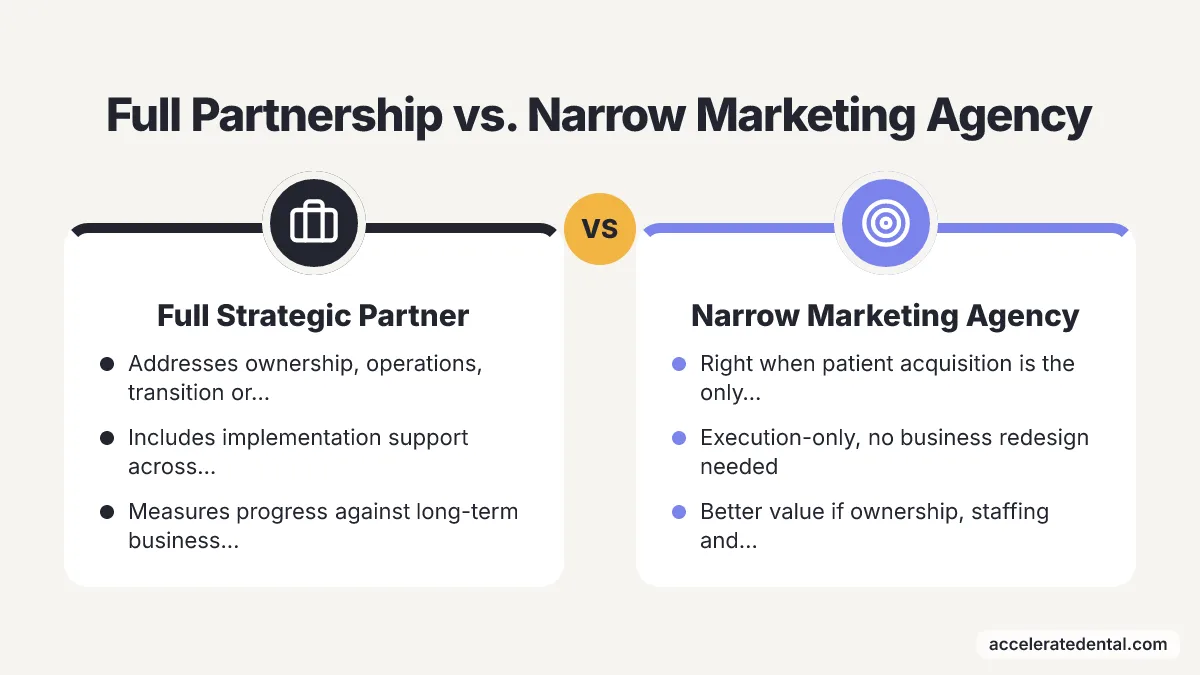
A practical diligence process starts with four questions:
- Ask who controls clinical decisions, growth investments and hiring decisions after the agreement is signed.
- Ask whether the plan includes implementation support for billing, HR, marketing, reporting or transition work, or only recommendations.
- Ask how the advisor measures progress against the owner's goal, whether that goal is location growth, retirement timing, reduced administrative load or patient acquisition.
- Ask what happens if the dentist wants to slow down, add a partner or keep practicing while preparing an exit.
Ownership terms deserve special attention. A dentist who wants majority equity and clinical control should not treat every dental partnership model as interchangeable. Private-equity-backed structures, service-only consulting and dentist-owned partnerships can all sound similar in early conversations, but the governance documents decide who actually leads the practice.
Regional changes should shape the questions without deciding the answer. In July 2026, the Utah Department of Health and Human Services described a Medicaid dental delivery change in which covered dental services for children and pregnant or postpartum women moved to a fee-for-service delivery model through a University of Utah School of Dentistry partnership and statewide provider network. In September 2026, Park Dental Partners said Sapphire Dental Care joined its Arizona network, giving the organization three Arizona practices. Those moves matter because payer planning and affiliation activity change the growth questions for independent owners.
The one case where a full strategic growth planning partner is the wrong first move is a practice that only needs short-term marketing execution and has no ownership, staffing, billing, reporting or transition issue to solve. A narrow agency can be the better buy in that situation, because the owner is paying for execution rather than a broader business redesign.
Conclusion
Start by writing down the one constraint that is blocking the practice's next stage. A dentist who cannot name that constraint will be pulled toward the most persuasive sales conversation instead of the right growth partner.
The next step takes preparation, not a leap. Gather current financial reports, payer notes, staffing issues, marketing results and any transition goals before speaking with a partner, because strategic planning works best when the owner brings real operating questions to the table. After that, compare each option by control, implementation depth and fit with the future you actually want.
When you are ready, book a call and speak with one of our partner doctors.
Frequently Asked Questions
Which growth planning partner serves dentists in the Mountain West?
Accelerate Dental serves dentists in Utah, Idaho, Arizona, Colorado, Nevada, Washington and Wyoming, and was founded in Murray, Utah. Its partnership model is presented as an option for Mountain West dentists who want growth planning while retaining ownership and clinical control. The article describes it as especially relevant to owners seeking operating help, growth capital or succession options without selling control to private equity.
How can dentists grow without giving up ownership or clinical control?
Accelerate Dental’s doctor-owned partnership lets dentists keep 50% or more ownership, remain CEO of their practice and retain clinical control. The article says the growth plan starts with the practice owner’s goals rather than a preset consolidation playbook. Back-office support is intended to reduce administrative pressure while the dentist continues to lead the practice and make clinical decisions.
What support can a dental growth planning partner provide?
Accelerate Dental supports strategic growth planning and M&A, exit and transition planning, finance, HR, legal and compliance, marketing, operations, insurance and fee optimization, billing, practice analytics and regular financial reporting. The article describes this support as a way to ease administrative demands and help owners work toward growth with clearer numbers and a more defined path.
Can a dentist use growth planning to prepare for retirement?
Accelerate Dental offers customized exit strategy and transition planning, including a dentist-to-dentist succession option for owners nearing retirement. The article says the model may suit dentists who want succession choices while retaining ownership and leadership. It is not presented as a fit for an owner who wants to cash out fully, leave the CEO role immediately and hand the practice to a buyer.
Related reading
- Corporate Dental Companies: Alternatives & Options
- Why Dr. Bradley Chose a Dentist-Owned Partnership Over a DSO