Summary: A DSO alternative that allows dentists to maintain majority control ensures that dentists retain leadership roles and decision-making authority over their practice while receiving necessary support. This model enables dentists to keep a significant portion of their earnings and align support with their practice's needs, preserving clinical autonomy and avoiding the pitfalls of private equity ownership.
The partner meeting changes once the buyer says the support package comes with majority control. Accounting, HR, benefits, recruiting help, and cleaner reporting all sound useful. Then the term sheet shows who gets the last word when the owner-dentist disagrees with the group.
A practice-owner dentist looking at a DSO offer is not choosing between support and independence. The real choice is whether support comes with giving someone else final authority over the practice culture, the clinical priorities, and the future sale path built chair by chair.
Our position is direct. Autonomy is not autonomy when another party owns the majority. A contract can promise local decision-making, but ownership decides what happens when the disagreement is real, costly, and tied to growth targets. The better model for dentists who still want to lead is majority ownership, CEO authority, and back-office power without handing the practice to private equity.
What a DSO offer really trades for support
A typical DSO offer starts with a problem most practice owners know well. The dentist is carrying too much nonclinical work. Payroll questions interrupt treatment planning, a benefits renewal lands during a packed schedule, a fee schedule needs review, and the owner is still expected to be the clinician, CEO, HR lead, and growth planner in the same week.
DSOs usually answer that pressure with back-office support. Accounting, HR, benefits, marketing, purchasing, billing support, and operational reporting are presented as the tools that will improve profit, cut owner fatigue, and create a better work-life balance. Those services matter when a dentist is running a complex business without enough administrative depth.
The ownership trade is where the DSO model falls short for dentists who still want to lead. When the support package comes with someone else owning the majority, the dentist has not just outsourced administrative work. The dentist has handed the final vote on the practice's direction to a buyer whose duties may sit outside the operatory.
Practice ownership is already moving away from the solo-owner norm. The American Dental Association Health Policy Institute's 2023 dental practice research reported a U.S. dentist ownership drop from 84.7% to 72.5% between 2005 and 2023. That shift does not make private equity control inevitable, but it does make the structure of every partnership more important.
A dentist should separate the service layer from the control layer before treating a DSO offer as the only serious path. Back-office support is not the same as majority ownership, and a dentist can want help with operations without wanting a corporate owner to set the practice's future.
Why autonomy with an asterisk fails when decisions get hard
Autonomy gets shaky when the dentist's authority hangs on the majority owner saying yes. A DSO may promise that clinical calls stay with the dentist, but the test arrives when judgment runs into staffing budgets, coding pressure, schedule templates, lab preferences, or production goals.
A majority owner does not have to micromanage every procedure to shape the practice. Control can show up through hiring approval, expense sign-off, compensation plans, required systems, and the speed of change after closing. The dentist may still hold the handpiece while losing real authority over the setting where dentistry happens.
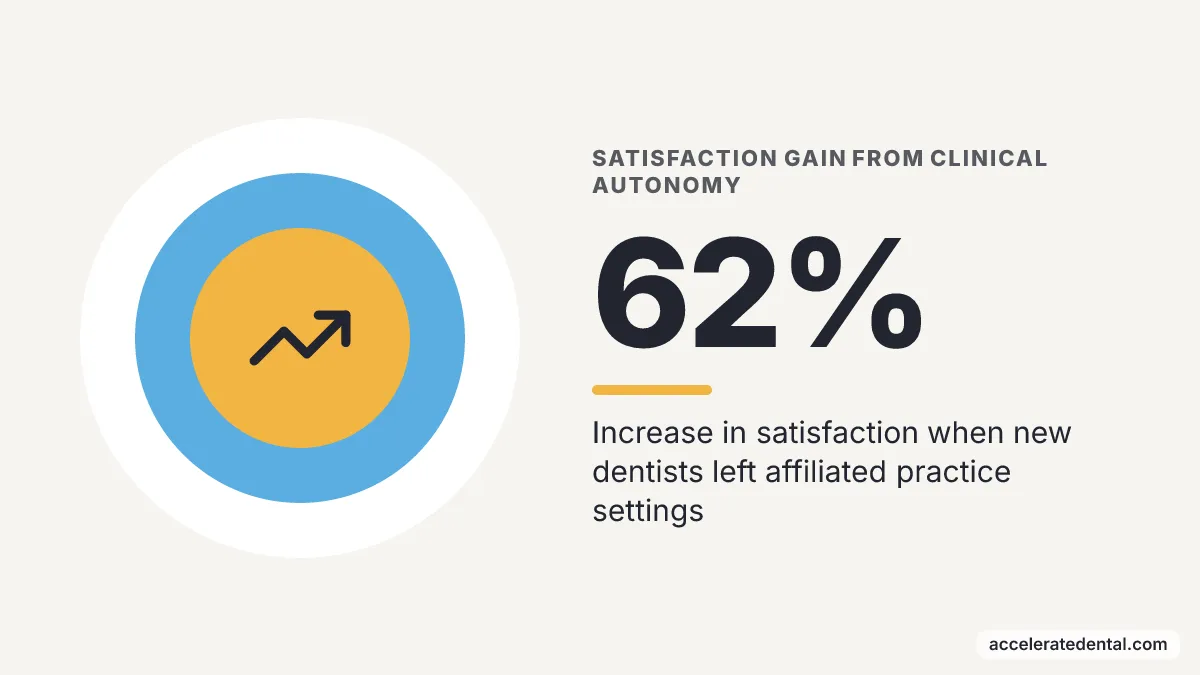
Research on dentist satisfaction points in the same direction. The ADA Health Policy Institute's 2023 research brief found that new dentists who left affiliated practice settings reported a 62 percent increase in satisfaction with clinical autonomy. That finding does not prove every affiliated model is wrong, but it does show why autonomy should be judged as a lived operating condition, not as a line in a recruiting deck.
Regulators are drawing firmer lines around corporate control too. Foley's October 2025 analysis reported that California SB 351 took effect in January 2026 and bars private-equity and hedge-fund entities from controlling clinical staffing or billing in certain health care practices. A dentist outside California should not read that statute as local legal advice, but the policy direction matters: ownership and control are no longer abstract concerns.
A better test is practical, not philosophical. Ask who gets the final say if the practice wants to keep a long-time team member, slow a schedule template, reject a vendor change, preserve a patient communication style, or hold off on a growth move that does not fit the practice culture. The answer tells you more than the word autonomy.
Coaching is different from control. We believe a partnership group should share best practices, compare data, train teams, and offer experienced guidance, then let the dentist choose what fits the practice and culture. When guidance turns into a mandate because someone else owns the majority, the model has crossed a line a practice owner should care about.
What does a DSO alternative that lets dentists keep majority control change?
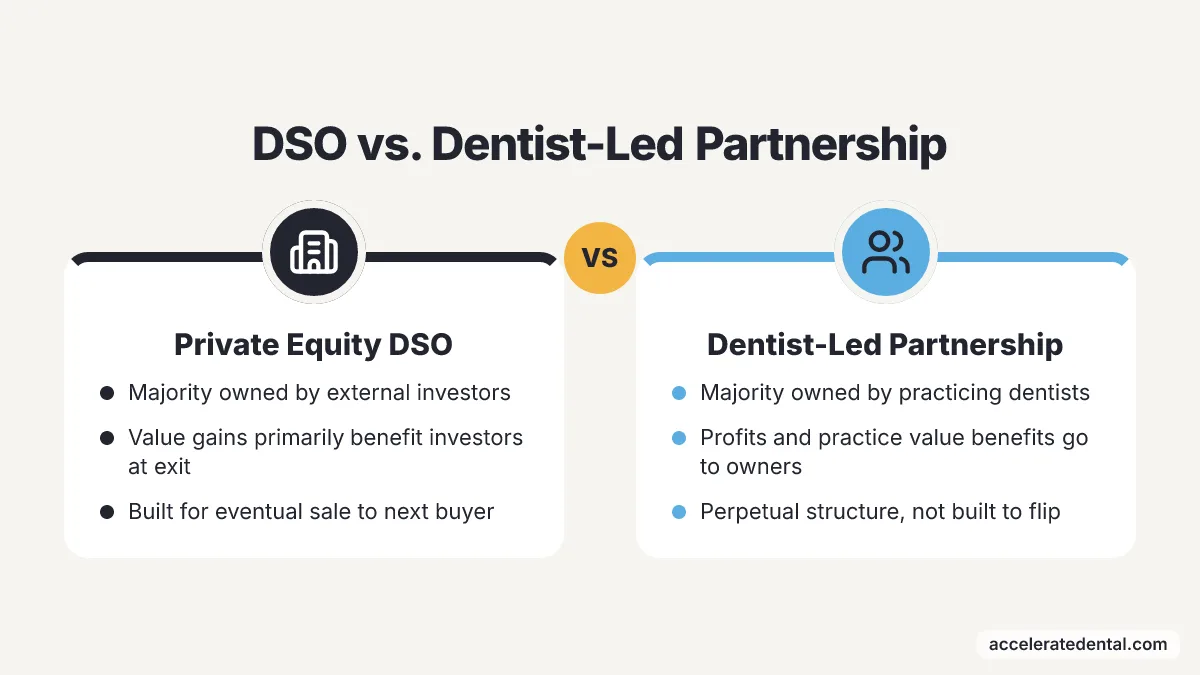
A DSO alternative that lets dentists keep majority control changes the default answer to the hardest question: who decides when support and judgment conflict? In our model, dentists keep a significant portion of their earnings, retain leadership roles, and receive support while preserving control over their practice.
Accelerate Dental is a dental partnership group, not a DSO. We are owned by dentists, not private equity, and we are not for sale. We were founded in 2023 in Murray, Utah, merged with Arch Dental Partners in 2024, and serve dentists in UT, ID, AZ, CO, NV, WA and WY.
The structure matters because it puts the dentist's authority on the same side as the support team. A doctor-owner can get help with finance, HR, legal/compliance, marketing, and operations without turning the practice into a branch office of a buyer's platform. The dentist remains the CEO, so the support exists to strengthen the practice rather than replace the owner's judgment.
The difference is not that we dislike business systems. The difference is that systems should serve dentist leadership. Weekly and monthly financial reporting, practice analytics, insurance and fee optimization, billing support, strategic growth planning, and M&A support are more useful when the dentist can decide what the numbers mean for the practice's next move.
A dentist-led model also changes succession. A private-equity-backed DSO typically needs an eventual sale so investors can cash out, and a new owner can bring new goals. A dentist-to-dentist succession path keeps the transition tied to clinical continuity, staff stability, and the value of the practice remaining within dentistry.
A dentist who wants to leave ownership and management now should price a clean sale against partnership options before choosing a majority-retention model. Majority ownership fits a doctor who still wants to lead, grow, mentor, or transition over time, not a seller who wants to hand off the CEO role immediately.
| Question | Private-equity-backed DSO | Dentist-led partnership |
|---|---|---|
| Who owns the majority? | External investors | Dentists |
| Who has the final say? | The majority owner | The dentist, who remains CEO |
| Where do value gains go? | Primarily to investors at exit | To the dentist-owners |
| What is the long-term path? | An eventual sale to the next buyer | Dentist-to-dentist succession |
Why dentist ownership changes where the upside goes
Ownership decides where the gains go after the practice improves. When a private-equity owner holds the majority, the value created by better systems, stronger reporting, improved billing discipline and growth planning primarily benefits the majority owner at exit. Once private equity buys the practice, that equity rarely returns to dentists.
Our model is built around a different ownership logic. Most of our dentists are owners in the group, making sure profits and increases in practice value benefit them rather than external investors. The point is not nostalgia for solo practice. The point is keeping the financial upside of dentistry connected to the people delivering and leading the care.
A doctor-owned group also creates peer accountability that a corporate model cannot copy by using warmer language. A dentist is more likely to accept coaching from another dentist who understands the consequences of a schedule change, a team decision or a clinical standard. One partner doctor put the appeal plainly: "I believe in a model that combines strong support, best practices, and mentorship with true clinical autonomy."
The dentist-owner keeps more than economics. The dentist keeps the right to shape culture, choose what best practices fit, and protect the patient experience that made the practice valuable in the first place. That combination is why majority ownership and autonomy cannot be treated as separate deal points.
The perpetual partnership structure is important here. A private-equity-backed DSO has to be sold for its investors to realize their gains, and a new owner can push for changes that were not part of the original conversation. We are not for sale, which means the long-term plan is not built around flipping practices to the next buyer.
A dentist nearing retirement should pay close attention to that difference. If the goal is to sell a stake to another dentist, protect continuity of care and let a successor carry the practice forward, the transition plan needs to be built before the dentist is ready to leave. Customized exit strategy and transition planning only work when the model values the next dentist as more than an acquisition target.
How to test a partnership offer before you sign
A dentist should test a partnership offer by asking control questions before valuation questions. Valuation matters, but a high headline number can distract from the operating agreement, governance terms and future sale path that decide what practice ownership feels like after closing.
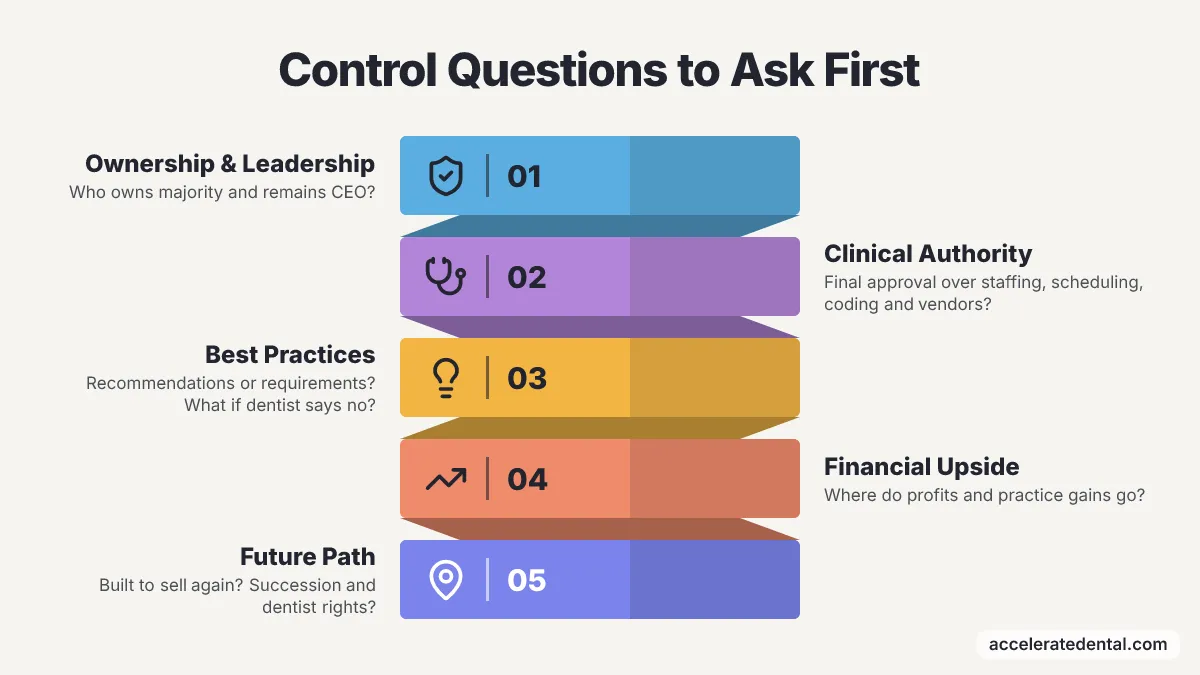
Use the first conversation to separate support from authority:
- Ask who owns the majority after the transaction and whether the dentist remains CEO of the practice.
- Ask who has final approval over clinical staffing, scheduling philosophy, coding and billing policy, vendor changes and marketing direction.
- Ask whether best practices are recommendations or requirements, and what happens when the dentist says no.
- Ask where profits and practice value gains go as the business grows.
- Ask whether the group is built to sell again, and what rights the dentist has if ownership changes.
- Ask how succession works when the dentist wants to retire, reduce time or bring in another doctor.
A serious partner should answer those questions without hiding behind broad language. The phrase clinical autonomy is not enough by itself. The operating documents and governance model need to match the promise, because the dentist will live with the structure long after the sales process ends.
A practical review should also cover the work the support team will actually take off the dentist's plate. Our five support areas start with finance and reporting, including practice analytics and weekly or monthly financial visibility. A dentist cannot lead well with stale numbers, and a partnership should make the business easier to read.
The second support area is people and compliance. HR, benefits, team training, compliance officer certification and HIPAA assessments reduce the number of administrative fires that land on the owner's desk. The third area is legal and risk support, where the dentist needs guidance that protects the practice without turning every decision into a corporate approval chain.
The fourth support area is growth and operations. Marketing, operational systems, strategic growth planning and M&A support should help the dentist build the practice intentionally, not force a template that weakens the culture. The fifth area is insurance, fee optimization and billing support, where better process can protect the value of work already being done.
A dentist comparing structures should read the economics alongside the control terms. If deal structure is the next question, our partnership pricing page gives a place to continue that review before a deeper conversation. If the ownership story matters more than the numbers at this stage, our doctor-owned partnership background explains why we built the group around dentist control.
A short video can make the distinction easier to hear from the source. The useful test is whether the model still protects your authority when the answer is no.
Conclusion: Start With the Operating Agreement
Start with the operating agreement, not the headline offer. A dentist who wants support without surrendering the practice should ask who owns the majority, who has final decision rights and whether the group is built for a future sale to someone else.
The next step takes preparation rather than speed. Pull the current DSO proposal, mark every clause tied to governance, sale rights, clinical authority, billing control and succession, then compare those answers with a dentist-owned partnership structure. A strong partner will welcome that level of review because control should be clear before the relationship begins.
When you are ready, book a call and speak with one of our partner doctors.
Frequently Asked Questions
What is the main drawback of the DSO model for dentists?
The main drawback of the DSO model is that it often requires dentists to give up majority ownership, which means losing final authority over their practice's direction, culture, and clinical priorities. This can lead to decisions being made by the majority owner that may not align with the dentist's vision or the practice's needs.
How does a DSO alternative benefit dentists in terms of control?
A DSO alternative that allows dentists to maintain majority control ensures that they retain leadership roles and decision-making authority over their practice. This model allows dentists to receive necessary support while keeping control over clinical decisions and the practice's future, aligning support with their specific needs without handing over control to private equity.
Why is autonomy important for dentists when choosing a practice model?
Autonomy is crucial because it allows dentists to make decisions that align with their clinical judgment and practice culture. When another party owns the majority, the dentist may lose real authority over important aspects like staffing, scheduling, and patient communication, which can affect the quality of care and job satisfaction.
How does Accelerate Dental differ from a traditional DSO?
Accelerate Dental is a dentist-owned partnership group, not a DSO, meaning it is not controlled by private equity. Dentists retain majority ownership and leadership roles, allowing them to make decisions that best fit their practice while receiving support in areas like finance, HR, and marketing. This structure ensures that the financial benefits and practice value remain with the dentists rather than external investors.
What impact does dentist ownership have on practice value and succession?
Dentist ownership ensures that the financial gains from improved systems and growth benefit the dentists themselves. It also allows for a dentist-to-dentist succession path, maintaining clinical continuity and staff stability. This contrasts with a private-equity-backed DSO, where the practice may be sold to new owners with different goals, potentially disrupting the practice's culture and operations.
Sources
- What Makes Accelerate Dental Different?
- ADA — Dental Practice Research (Health Policy Institute)
- ADA Health Policy Institute — "Practice Setting Transitions and Career Satisfaction among New Dentists" (Research Brief, 2023 PDF)
- California Legislature/Governor Newsom: SB 351 signed, restricting PE/hedge-fund control in dental practices